
Estimated reading time: 3 minutes
Acids are now widely used in modern pig production, as feed acids contribute to stable conditions in feed and drinking water. When used correctly, acids can help create a more uniform feeding environment and reduce variations in feed quality throughout the production cycle.
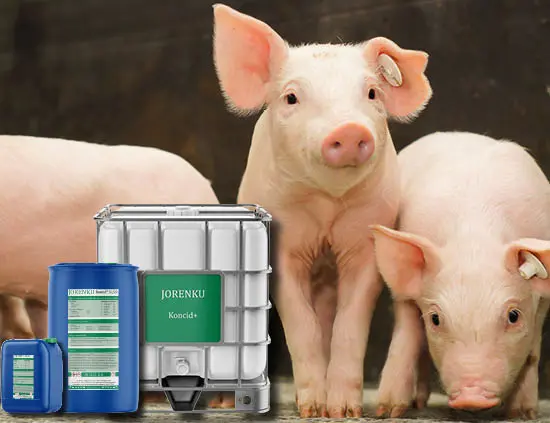
Feed acids contribute to stable conditions in pig herds by protecting against viruses, harmful micro-organisms and fungi.
pH control and feed quality
One of the primary functions of feed acids is to lower the pH in feed and water. This creates adverse growth conditions for harmful microorganisms and at the same time helps maintain feed quality from mixing to intake.
Feed acids can, among other things:
- Inhibit the development of harmful microorganisms.
- Counteract free fermentation in liquid feed.
- Contribute to more uniform feed quality.
- Support stable feeding conditions.
Jorenku’s acid solutions – different applications in practice
The choice of feed acid depends on feed type, application and the conditions that are relevant for the individual herd. At Jorenku, a range of acid solutions is used for different purposes within pH control, preservation and stabilisation of feed.
Jorenku’s blended acids include:
- Koncid+, used for lowering the pH and the creation of stable conditions in complete feed and wet feed.
- Dancid® 80/20, used for the preservation of wet feed and to counteract unwanted fermentation.
- Dancid®+, used in both wet feed and drinking water where pH control and stabilisation are required. At the same time, the feed’s taste is improved.
- Dancid® Farma, used where the focus is on reducing loss of nutrients and inhibiting free fermentation.
- Dancid® Farma+, used in applications where feed stabilisation and prevention of harmful microorganisms are key objectives.
- Dancid® Ferma, primarily used to reduce the risk of free fermentation, mildew and mould.
- Dancid® Soft, used where lowering the pH and preservation are required with a more gentle composition to the equipment.
- Propionic Acid+, used for the preservation of grain collection facilities and complete feed rations.
The individual acid solutions are selected based on conditions and feeding systems, and the choice should always be based on the specific application.
Stable operation and uniform feeding conditions
Variations in feed quality can create challenges in the daily operation. Feed acids are used to preserve feed and reduce the risk of unwanted fermentation, yeast and mould – particularly in wet feed systems.
Adaptation to the individual herd
Different types of acid solutions are available and can be used depending on feed type, production system and operating conditions. The choice of acid and dosage should always be based on the specific application and local conditions.
At Jorenku, acid solutions are developed and used with a targeted focus on specific purposes within feed and feeding systems.